Nicotine Gum and Patches in Japan: Where to Buy
Find Nicorette and Nicotinell, compare gum with patches, and understand the Japanese instructions before you buy.
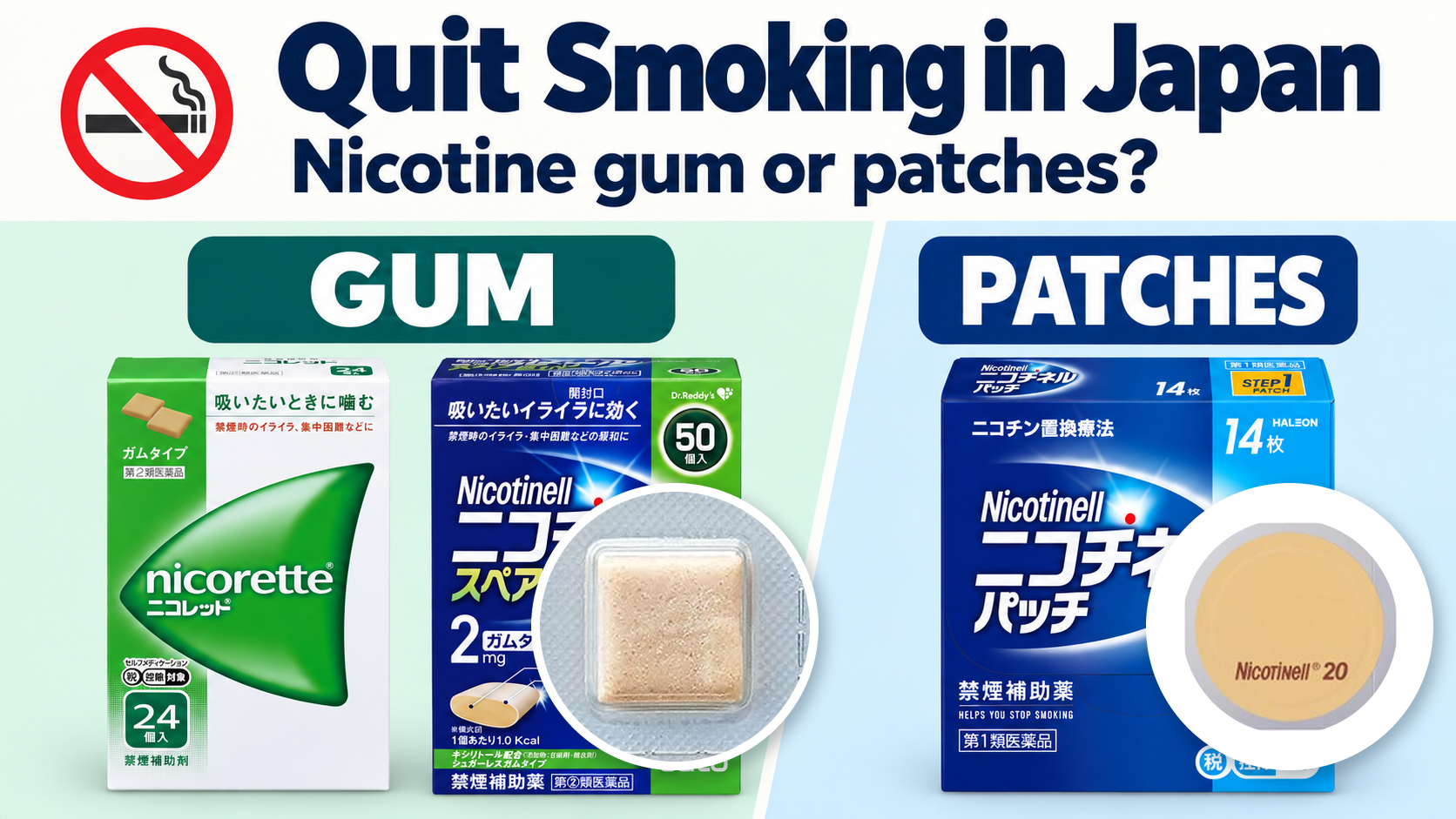
Nicotine gum and patches are medicines for people who want to stop smoking. They contain nicotine to ease withdrawal symptoms such as irritability, difficulty concentrating, and restlessness. They do not make you dislike tobacco.
In Japan, look for Nicorette (ニコレット) gum or Nicotinell (ニコチネル) gum and patches at pharmacies, drugstores, or online. No prescription is needed, but patches require a pharmacist’s check before purchase.
Three things to know before buying:
- Gum: chew slowly, then rest it between your cheek and gum. Repeat for 30-60 minutes.
- Patches: apply one in the morning and remove it at bedtime under the Japanese instructions.
- Do not combine them or smoke during use or immediately afterward. Stop smoking completely when starting treatment.
Nicotine gum vs patches: what's the difference?
The main everyday difference is how you use them. Gum is used when you feel the urge to smoke; a patch is applied once a day and worn until bedtime.
Swipe sideways to see all columns.
| What to compare | Nicotine gum | Nicotinell patches |
|---|---|---|
| Names to look for | Nicorette; Nicotinell Mint, Spearmint, or Mango | Nicotinell Patch 20 and Patch 10 |
| How you use it | 1 piece at a time, chewing and resting for 30-60 minutes | 1 patch daily, from waking until bedtime |
| Treatment schedule | Reduce gradually; aim to finish in about 3 months | Patch 20 for 6 weeks, then Patch 10 for 2 weeks |
| Medicine class | Designated Class 2: pharmacist or registered salesperson | Class 1: pharmacist consultation before purchase |
| A practical point | Can stick to dentures; do not use with a jaw-joint disorder | Change the application site daily; do not apply to damaged or diseased skin |
Both have health conditions and medicines that need checking before use. The warnings below explain those checks.
Is Nicorette available in Japan?
Yes. The Nicorette (ニコレット) gum shown below contains 2 mg of nicotine per piece. The Nicotinell Mint, Spearmint, and Mango gums covered here also each contain 2 mg per piece, with the same dosing schedule in their Japanese inserts.
Nicotinell Mint (ミント) is peppermint flavored; Spearmint (スペアミント) and Mango (マンゴー) are the other flavors covered here. Their additive lists differ, so check the ingredients of the exact product if you have allergies.
Where to buy nicotine gum and patches in Japan
At a pharmacy or drugstore
Ask for the product by name, or show the Japanese text below on your phone.
| What you want to ask | Japanese to say or show the staff |
|---|---|
| Do you have Nicorette? | ニコレットはありますか?Nikoretto wa arimasu ka? |
| Do you have Nicotinell patches? | ニコチネルのパッチはありますか?Nikochineru no patchi wa arimasu ka? |
| Is a pharmacist available now? | 今、薬剤師さんはいますか?Ima, yakuzaishi-san wa imasu ka? |
Gum is labeled 指定第2類医薬品 or 第②類医薬品. A pharmacist or registered salesperson can sell it. Nicotinell patches carry 第1類医薬品, so speak with the pharmacist before buying. They will explain how to use the patches and check whether they are suitable for you. Check that a pharmacist is available when you visit.
OTC Guide Japan's medicine-class guide explains these labels. If you're reading the box in the aisle, our guide to Japanese medicine packaging shows where to find ingredients and warnings.
On Amazon Japan
The links below go to the specific pack shown. Check the name and pack size when ordering.


A 14-patch box covers 14 days at one patch a day. It is not the full treatment course. Patch 20 is the first step; Patch 10 is the second step in the standard schedule below.
For online patch purchases, you also need to complete the pharmacist's check. The pharmacist's explanation and your replies may be handled by messages or email. The Amazon patch listing says a pharmacist checks appropriate use before shipment. Confirmation can delay shipment or result in cancellation. For examples of the medicine-ordering screens, see How to Order Medicine on Amazon Japan.
These are affiliate links. If you buy through them, OTC Guide Japan may earn a commission at no extra cost to you.
How to use Nicorette and Nicotinell gum
Use 1 piece when you want to smoke. The chewing-and-resting technique matters:
- Chew slowly until you notice a tingling or peppery taste, about 15 chews in the illustrated instructions.
- Rest it between your cheek and gum until the taste fades, about 1 minute or longer.
- Repeat for a total of 30-60 minutes.
- Wrap the used gum in paper and discard it where children cannot reach it.
Do not swallow it. If it feels irritating, stop chewing and rest it inside your cheek. Never chew 2 or more pieces at once, or use more than 24 pieces in one day.
How many pieces a day?
The Japanese inserts give these starting amounts, based on how much you smoked before quitting:
| Cigarettes per day before quitting | Suggested initial gum use per day |
|---|---|
| 20 or fewer | 4-6 pieces |
| 21-30 | 6-9 pieces |
| 31 or more | 9-12 pieces |
Once you have become used to not smoking, around 1 month, reduce your daily total by 1-2 pieces each week. Stop when you are down to 1-2 pieces a day. Aim to finish in about 3 months. Consult a doctor, pharmacist, or registered salesperson before continuing beyond 3 months, bringing this package insert with you; do not use for more than 6 months. Long-term or heavy use can carry nicotine dependence over to the gum.
Wait a while after coffee or carbonated drinks before using the gum; the Japanese inserts do not specify an exact waiting time. Do not use it at the same time as inhalers or sprays used inside the mouth. Take care with dentures: the gum can stick to them, causing loosening or damage.
How to use Nicotinell patches in Japan
Apply 1 patch on waking and remove it at bedtime. Follow this schedule:
Swipe sideways to see all columns.
| Treatment period | Product | Daily use |
|---|---|---|
| Weeks 1-6 | Nicotinell Patch 20 | 1 patch from waking until bedtime |
| Weeks 7-8 | Nicotinell Patch 10 | 1 patch from waking until bedtime |
After 6 weeks of Patch 20, you may finish without Patch 10 if withdrawal symptoms have gone, you are strongly committed to continuing, and you feel confident you can remain smoke-free, as described in the insert.
What do “20” and “10” mean on the box?
The Japanese insert lists Patch 20 as 20 cm², containing 35 mg of nicotine, and Patch 10 as 10 cm², containing 17.5 mg. The numbers in the names are not the nicotine content in milligrams. Follow the product schedule above when choosing the first or second step.
Where to put it and what to avoid
Apply to an upper arm, abdomen, or lower back. Change the site every day. Dry wet skin before application and press firmly for about 10 seconds. Avoid wounds, eczema, rashes, other diseased skin, the belt line, and densely hairy areas.
- Do not wear 2 or more patches at once, cut a patch, or use continuously for more than 8 weeks.
- Do not use a sauna or do strenuous exercise while wearing one.
- Remove it before MRI, diathermy treatment, or electrical defibrillation such as an AED, because it can cause burns at the application site.
After 1 week, stop and consult a doctor or pharmacist if your cigarette count has not decreased at all, or withdrawal symptoms have not eased and you cannot continue quitting, bringing this package insert with you. Smoking during treatment remains prohibited.
Who must not use these medicines?
The inserts prohibit use by people who:
- Have never smoked or do not currently smoke.
- Are already using another nicotine medicine.
- Are pregnant or possibly pregnant.
- Have severe heart disease: a heart attack within the past 3 months, doctor-diagnosed severe angina, or doctor-diagnosed severe arrhythmia.
- Have a doctor-diagnosed cerebrovascular disease in its acute stage, such as a cerebral infarction or cerebral hemorrhage.
- Have been diagnosed with depression. The Nicotinell inserts explicitly include a previous diagnosis.
- Have had an allergic reaction to that product or its ingredients.
Gum also must not be used by people with a jaw-joint disorder.
The breastfeeding instructions differ: patches must not be used while breastfeeding. For gum, the inserts say not to use it while breastfeeding, or to avoid breastfeeding if using it. Nicotine passes into breast milk.
When to ask before using nicotine gum or patches
Ask before starting if you are under medical treatment, take other medicines, are elderly or under 20, or have a history of medicine allergies. The product-specific lists below include the other symptoms and conditions that need checking.
Before using gum: conditions and medicines to check
For gum, consult a doctor, dentist, pharmacist, or registered salesperson before use if you:
- Are under medical treatment, including dental treatment.
- Are using other medicines.
- Are elderly or under 20.
- Have had an allergic reaction to a medicine or similar substance.
- Have abdominal pain, chest pain, mouth ulcers, a sore throat, or a swollen throat.
- Have been diagnosed with heart disease, cerebrovascular disease, peripheral vascular disease such as Buerger's disease, high blood pressure, a thyroid disorder, pheochromocytoma or paraganglioma, diabetes treated with insulin, pharyngitis, esophagitis, a stomach or duodenal ulcer, liver disease, or kidney disease.
The Nicorette insert also specifically lists epilepsy among conditions requiring consultation.
Before using patches: conditions and medicines to check
For patches, consult a doctor or pharmacist before use if you:
- Are under medical treatment.
- Are using other medicines.
- Have had an allergic reaction to a medicine or similar substance.
- Are elderly or under 20.
- Have a fever.
- Have been diagnosed with heart disease, a stomach or duodenal ulcer, high blood pressure, liver disease, kidney disease, diabetes treated with insulin, hyperthyroidism, pheochromocytoma or paraganglioma, cerebrovascular disease, peripheral vascular disease such as Buerger's disease, a widespread skin disorder such as atopic or eczematous dermatitis, epilepsy, or a neuromuscular junction disorder such as myasthenia gravis or Eaton-Lambert syndrome.
These consultation lists do not override the “must not use” conditions above.
Side effects and signs to act on
With gum
Stop using it and consult a doctor, pharmacist, or registered salesperson, bringing this package insert with you, if you develop:
- Mouth or stomach symptoms: mouth ulcers, a sore throat, nausea, vomiting, abdominal discomfort, heartburn, loss of appetite, or diarrhea.
- Skin or facial symptoms: a rash, redness, itching, facial flushing, or facial swelling.
- Other symptoms: headache, dizziness, slowed thinking, drowsiness, palpitations, chest discomfort or irritation, or feeling unwell.
Mouth or throat irritation, tongue irritation, an unusual taste, increased saliva, gum inflammation, jaw pain, hiccups, or burping may also occur. If these persist or worsen, stop and consult a doctor, dentist, pharmacist, or registered salesperson, bringing this package insert with you. Slower chewing may reduce the mouth-related irritation described in the inserts.
After excessive use or accidental ingestion by a child, nausea, increased saliva, abdominal pain, diarrhea, sweating, headache, dizziness, hearing problems, or generalized weakness can indicate acute nicotine poisoning. Seek advice immediately from a doctor, pharmacist, or registered salesperson, bringing this package insert with you.
With patches
If side effects occur, remove the patch immediately, rinse the skin with water without soap, and dry it. Consult a doctor or pharmacist, bringing this package insert with you, if symptoms continue. Reported effects include skin irritation or rash, insomnia, headache, dizziness, nausea, abdominal pain, palpitations, increased blood pressure, chest pain, and breathlessness. Generalized fatigue with yellowing of the skin or whites of the eyes is also listed; the insert gives additional symptoms.
Rarely, shock (anaphylaxis) may occur soon after application. Hives, swelling, or chest tightness together with a pale face, cold hands and feet, cold sweats, or difficulty breathing require immediate medical attention.
Signs of excessive nicotine include nausea, vomiting, diarrhea, severe abdominal pain, drooling, pallor, headache, sweating, dizziness, shaking, seizures, hearing or vision problems, confusion, generalized weakness, or breathlessness. Remove the patch, rinse with water without soap, dry the skin, and consult a doctor or pharmacist immediately.
The patch insert identifies a higher risk of excessive exposure in people who metabolize nicotine slowly, smoke few cigarettes and have low dependence, tend not to inhale deeply, or have a small build or are thin.
Keep used gum and patches away from children
Keep both unused and used products out of children's reach. Wrap used gum in paper. Fold a used patch in half with the adhesive sides together before disposal.
The patch insert warns that used patches still contain enough nicotine to cause severe poisoning or death in a child. If a child puts one in their mouth, remove it immediately. If swallowed, seek medical attention immediately; do not try to make the child vomit by giving lukewarm water or milk.
Sources and Japanese package inserts
OTC Guide Japan translated and explained the Japanese package inserts for Nicorette, Nicotinell Mint, Nicotinell Spearmint, Nicotinell Mango, and Nicotinell Patch 20/10. You can find the originals through the official pages below. Always read the insert that comes with your medicine.
- Nicorette official product information and Japanese package insert
- Nicotinell gum official information and package-insert downloads
- Nicotinell patch official information and package-insert download
- Nicotinell official product lineup and medicine classes
- MHLW: medicines that registered salespersons and pharmacists can sell
- MHLW: pharmacist information requirements for Class 1 medicines, including online sales