Seirogan in Japan: Original vs Toi-A vs Quick C
Same maker, same wood creosote, three forms. Here's how the original pills, Toi-A tablets, and Quick C capsules differ.
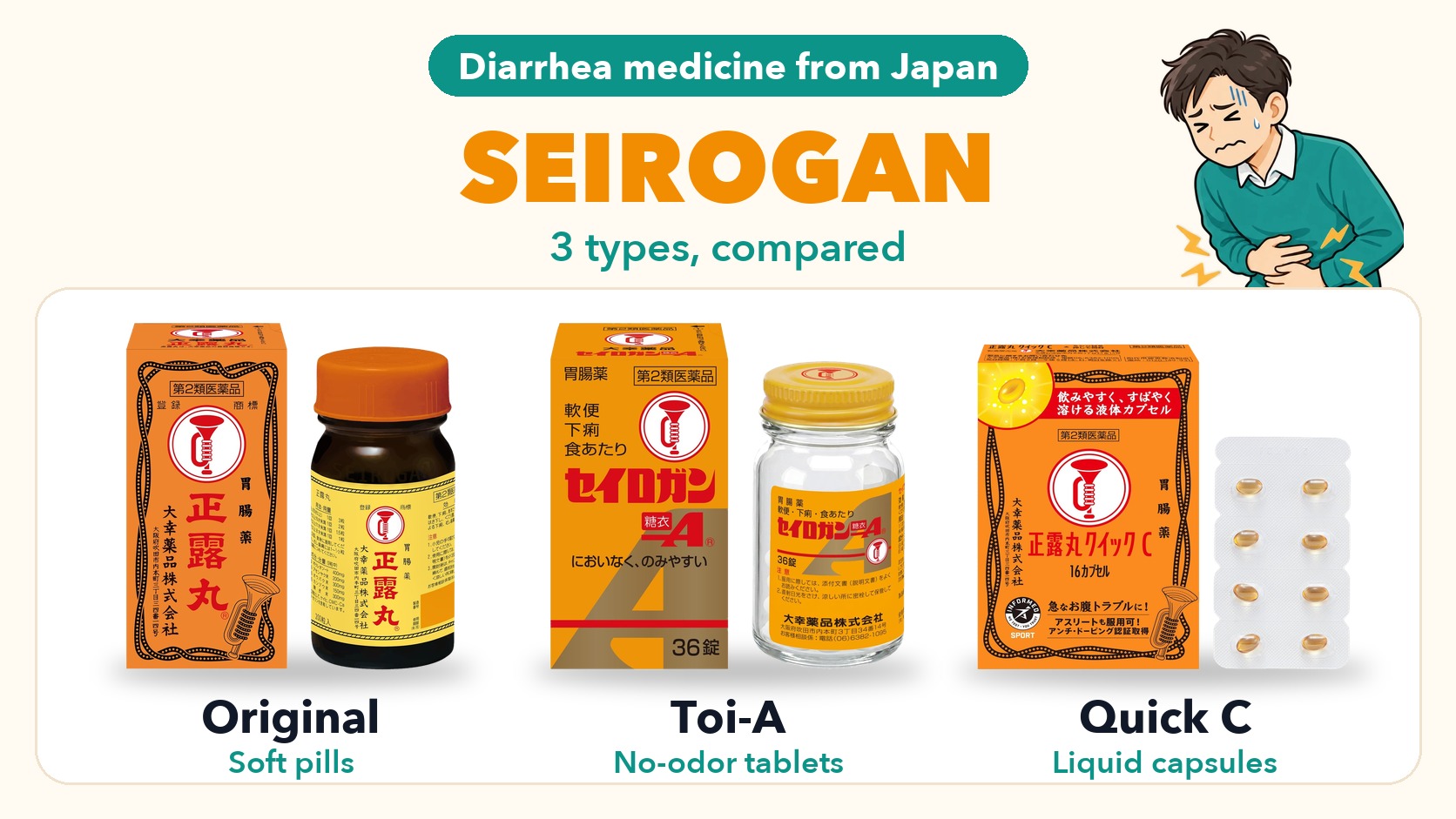
Ask for 正露丸 (Seirogan) at a Japanese drugstore and you might be shown three different boxes. The original is a bottle of soft, black-brown pills. Toi-A is a white sugar-coated tablet. Quick C is a liquid capsule. All three come from Taiko Pharmaceutical (大幸薬品), and all three are built on the same crude drug: wood creosote.
This page compares them using their Japanese package inserts, which OTC Guide Japan has translated into English, plus Taiko's own Seirogan brand site for things the inserts don't cover, like smell.
Quick summary
- Seirogan (正露丸): soft pills with a smell. Adults take 3 pills, 3 times a day after meals. Also used for toothache.
- Seirogan Toi-A (セイロガン糖衣A): white sugar-coated tablets with no smell. Adults take 4 tablets, 3 times a day after meals. Not for people on dialysis.
- Seirogan Quick C (正露丸クイックC): liquid capsules with a milder smell. Ages 11 and up take 2 capsules when symptoms appear, up to 3 times a day.
- All three can be taken from age 5 and are Class 2 medicines.
Seirogan vs Toi-A vs Quick C at a Glance

Seirogan正露丸
Soft black-brown pills · smell: yes
Wood creosote 400 mg/day · 5+
Plus four herbal powders. The only one also used for toothache.

Seirogan Toi-Aセイロガン糖衣A
White sugar-coated tablets · smell: none
Wood creosote 270 mg/day · 5+
Plus geranium herb powder and phellodendron bark extract.

Seirogan Quick C正露丸クイックC
Liquid capsules · smell: milder than Seirogan
Wood creosote 270 mg/day · 5+
Wood creosote only, in a capsule that releases it quickly.
Wood creosote is per maximum adult daily dose: 9 Seirogan pills, 12 Toi-A tablets, or 3 doses of Quick C (its insert lists 90 mg per 2 capsules). Every ingredient is listed on each product page.
Which Seirogan Doesn't Smell?
Toi-A. Its package insert calls it an odorless, easy-to-swallow white tablet, and Taiko's brand site rates its smell as "none."
The same brand site rates the original Seirogan's smell as "yes" and Quick C's as "milder" compared with the original. The package inserts for those two don't mention smell at all.
Where does the smell come from? Taiko says it's the wood creosote itself, the main ingredient, which is made by repeatedly distilling wood tar from trees such as beech and pine. On its comparison page, Taiko suggests choosing between Seirogan and Toi-A depending on how you feel about the smell and the situation you're in.
How to Take Seirogan, Toi-A and Quick C
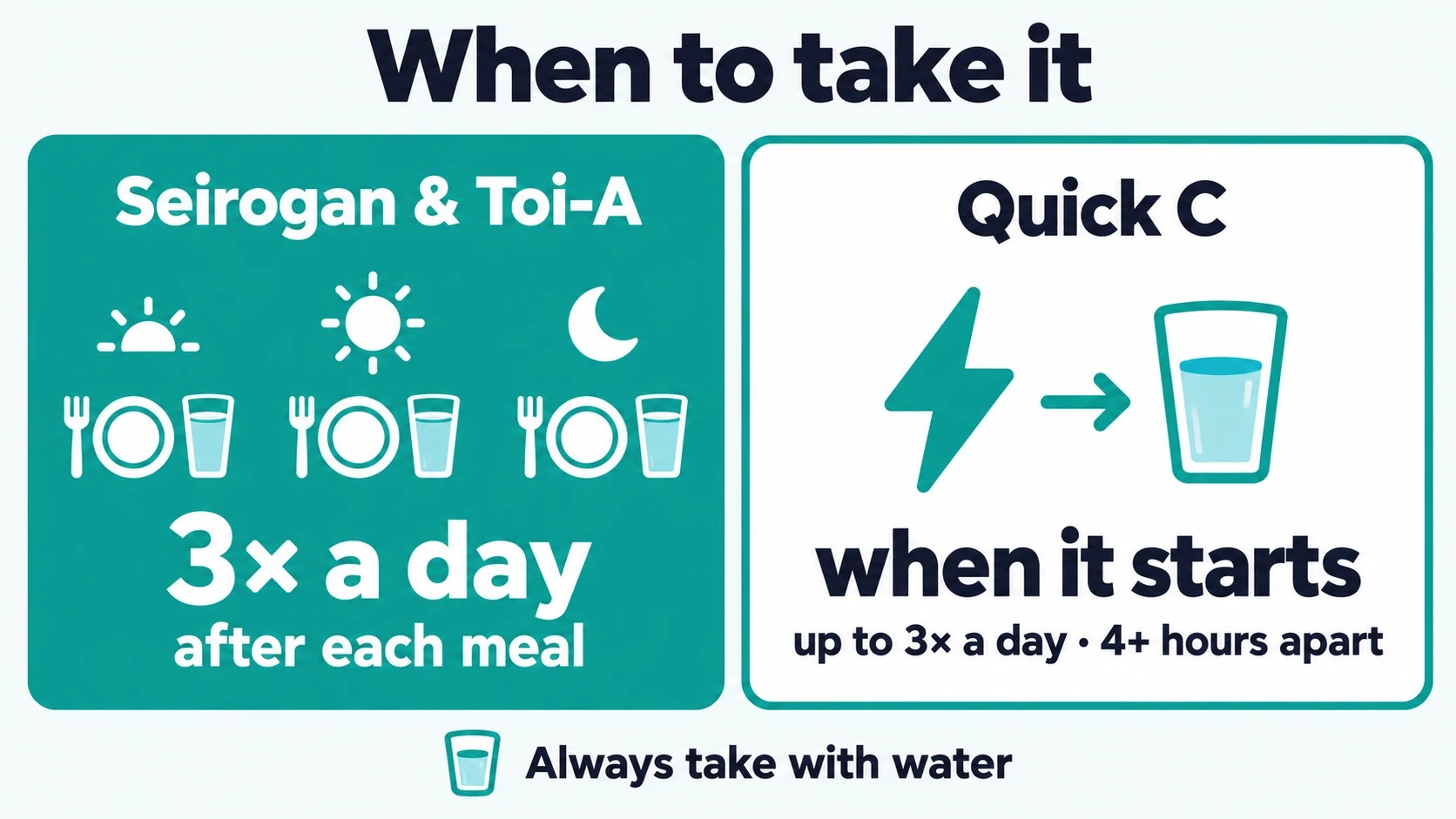
- Seirogan: 3 times a day, after meals (within 30 minutes if possible). Ages 15 and up take 3 pills, 11 to 14 take 2, 8 to 10 take 1.5, and 5 to 7 take 1.
- Toi-A: 3 times a day, after meals (within 30 minutes if possible). Ages 15 and up take 4 tablets, 11 to 14 take 3, and 5 to 10 take 2.
- Quick C: not tied to meals. Taiko says to take it when diarrhea or soft stools start. Up to 3 times a day, at least 4 hours apart. Ages 11 and up take 2 capsules, 5 to 10 take 1.
All three: always take with water or lukewarm water, don't give them to children under 5, and children should take them under adult supervision. Taiko's brand site also says not to take them with other antidiarrheal medicines, and that none of the three contains ingredients that cause drowsiness.
Why 3 times a day?
Taiko's brand site says one dose of Seirogan or Toi-A may only ease diarrhea for a while, and that the correct way to take them is 3 times a day. They're taken after meals so that food in the stomach dilutes the medicine and goes easier on the stomach lining.
Can't wait until after a meal, say in the middle of the night? The same page says to drink plenty of water first, then take one dose with about a glass of water or lukewarm water, and to leave at least 4 hours between doses.
Seirogan for Toothache
Only the original Seirogan lists toothache. Its insert says to pack ½ to 1 pill into the cavity of the decayed tooth.
It only relieves the pain for a while and doesn't treat the tooth. Once the pain eases, take the pill out of the cavity; never leave it packed in. See a dentist as soon as possible even if the pain has gone, and if it doesn't stop after 1 or 2 uses, stop and consult a dentist.
Seirogan Side Effects and Warnings
- Side effects (Seirogan and Toi-A): rash, redness, itching, or swelling; nausea or vomiting, constipation, loss of appetite, or stomach discomfort; dizziness or headache. Stop and talk to a doctor, pharmacist, or registered salesperson if they appear (Seirogan's insert also lists a dentist).
- Side effects (Quick C): loss of appetite or stomach discomfort. Its insert adds that a large amount of wood creosote can cause stomach problems and reduce appetite.
- Rare but serious (Seirogan): liver problems, with general fatigue or jaundice (yellowing of the skin or whites of the eyes). See a doctor right away.
- Toi-A only: don't take it if you are on dialysis, and don't take it continuously for a long time.
- Before you take any of them: talk to a doctor, pharmacist, or registered salesperson first if you have diarrhea with a fever, bloody stools, or mucus in your stools that continues, if you are elderly, or if you are under medical treatment. The Seirogan and Toi-A inserts also list pregnancy or breastfeeding, past allergic reactions to medicines or cosmetics, and liver or kidney disease.
- Pregnancy and breastfeeding: Taiko's FAQ says Quick C can be used. For Seirogan and Toi-A, it says they contain no ingredient that pregnant or breastfeeding women must not take, but to check with your regular doctor, a pharmacist, or a registered salesperson before taking them, just in case.
- How long: if you're no better after 5 to 6 days, stop and consult a doctor, pharmacist, or registered salesperson (Seirogan's insert also lists a dentist).
- Quick C capsules: push each capsule out through the foil. Swallowing one still in its sheet can injure your throat.
Tap a product name above for its full warnings in English.
Is Wood Creosote the Same as Creosote?
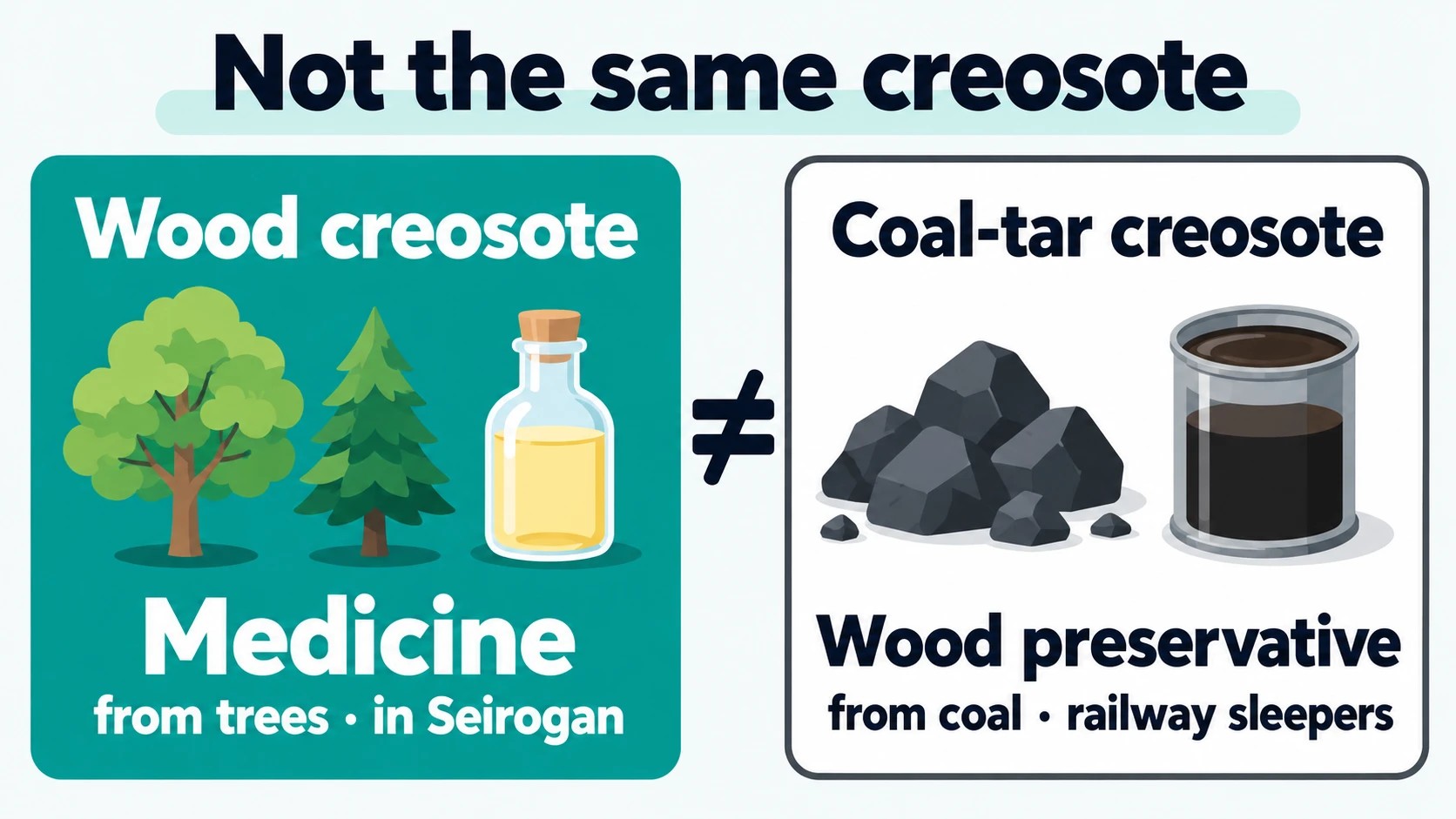
No. The Seirogan and Toi-A inserts explain that wood creosote is a crude drug, and that industrial creosote (coal-tar creosote, extracted from coal) is a completely different substance with different raw materials, components, and uses. They add that carcinogenicity tests found no carcinogenicity in this wood creosote. Taiko's brand site describes the two: wood creosote is a pale yellow, clear liquid used as a medicine, while coal-tar creosote is a black-brown liquid used to preserve wood such as railway sleepers and utility poles.
The Quick C insert describes wood creosote as a clear liquid obtained from trees such as beech and pine. All three inserts give it the same job: calming excessive movement in the large intestine and adjusting the amount of water in the bowel. Looking for loperamide instead? See Imodium in Japan.
Buying Seirogan in Japan
All three are Class 2 medicines (第2類医薬品), sold at drugstores. None of them contains an ingredient on Japan's abuse-prevention list. Pack sizes on Taiko's product pages:
- Seirogan: 100, 200, or 400 pills
- Toi-A: 36 or 84 tablets, a 48-tablet PTP pack, or a 24-tablet carrying case
- Quick C: 16 capsules
Words on the box
- 正露丸 (seirogan): Seirogan
- 糖衣 (tōi): sugar-coated
- 胃腸薬 (ichō-yaku): gastrointestinal medicine
- 下痢 (geri): diarrhea
Asking for it
「正露丸はありますか?」
Seirogan wa arimasu ka?
"Do you have Seirogan?" Read it out, or show this text on your phone.
This page summarizes the Japanese package inserts for these three products and Taiko Pharmaceutical's Seirogan brand site (November 2026). OTC Guide Japan translated and explained them in English, and each product page links the Japanese PDF. It is for information only and doesn't replace advice from a doctor or pharmacist. Always read the package insert that comes with the medicine.