Abuse-Prevention Medicines in Japan: What That Sign Means
What 指定濫用防止医薬品 Means for You as a Buyer
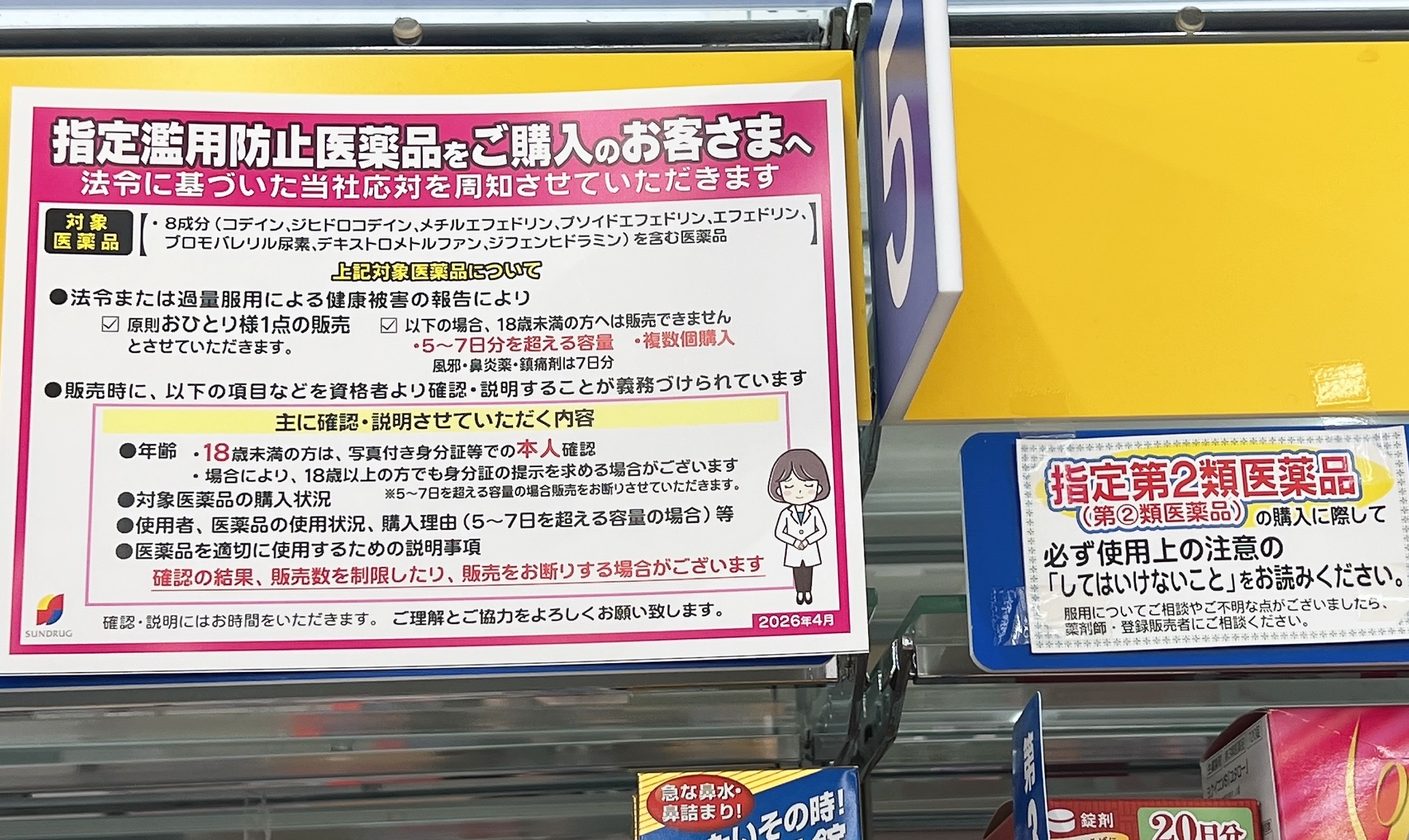
You're browsing the medicine aisle at a Japanese pharmacy when you notice a large notice posted at the counter. It's addressed directly to you — the customer — and it mentions something called 指定濫用防止医薬品. The pharmacist asks you a couple of questions before handing over your purchase. What's going on?
This guide explains what that label means, why the Japanese government introduced it, and what you should expect the next time you reach for a sleep aid, cough medicine, or cold remedy.
Why this designation exists
Over the past decade, Japan has seen a sharp rise in OTC medicine misuse — particularly among teenagers and young adults who take sleep aids and cough medicines in large doses to get high or numb difficult emotions. This is known as オーバードーズ (overdose), or simply "OD" in Japanese youth culture, and it has become a genuine public health concern.
In response, the Ministry of Health, Labour and Welfare (厚生労働省) established a special category of medicines that require stricter controls at the point of sale. As of May 1, 2026, this category was formally written into law as 指定濫用防止医薬品 — literally, "designated abuse-prevention medicines."
What it means when you buy one
1 box per visit
Limited to one unit per person per transaction — both in-store and online.
Under 18? Extra rules apply
Only small-pack sizes available — enough for 5–7 days. Multiple items cannot be purchased.
Pharmacist check required
A pharmacist or registered salesperson must confirm appropriate use before completing the sale.
If the pharmacist isn't satisfied with the answers, they have the right to refuse or limit the sale. This isn't personal — it's part of the system, and it applies to everyone.
Which medicines are affected?
The designation applies to any medicine containing one or more of these 8 ingredients:
| Ingredient | Found in |
|---|---|
| Diphenhydramine ジフェンヒドラミン |
Sleep aids |
| Dextromethorphan デキストロメトルファン |
Cough medicines, cold medicines |
| Codeine コデイン |
Cough medicines |
| Dihydrocodeine ジヒドロコデイン |
Cough medicines |
| Ephedrine エフェドリン |
Cold medicines, nasal decongestants |
| Pseudoephedrine プソイドエフェドリン |
Cold medicines, nasal decongestants |
| Methylephedrine メチルエフェドリン |
Cold medicines (liquid only) |
| Bromvalerylurea ブロモバレリル尿素 |
Sedatives, pain relievers |
These aren't obscure ingredients — they appear in very common medicines you'll find on the shelves of any Japanese pharmacy or drug store.
What to expect at the counter
Don't be surprised if the pharmacist pauses before handing over your purchase. Here's roughly how a real interaction goes — this is what one reader reported being asked at a Tokyo pharmacy:
"To purchase this medicine, I need to ask you a few questions."
"This medicine is for cold symptoms — are you currently experiencing cold symptoms?"
"Is this for your own personal use?"
"When did you last purchase this medicine?"
"Do you have any other questions?"
That's it. Four questions, honest answers, and you're done — the whole exchange takes under a minute. The pharmacist isn't interrogating you; they're fulfilling a legal requirement before completing the sale.
One practical note: don't try to buy two boxes in the same visit, even if you're stocking up. The limit is one unit per transaction, and the system is designed to flag this.
On this site
Any medicine on OTC Guide Japan that carries this designation will show an ⚠️ Abuse-Prevention Designated badge on its product page, along with a full explanation of the purchase rules. You'll find this across multiple categories — sleep aids, cold & flu medicines, cough medicines, and more.
If you're unsure whether a medicine you're looking at is on the list, check the product page on this site, or ask the pharmacist directly. They're there to help.